Flagged
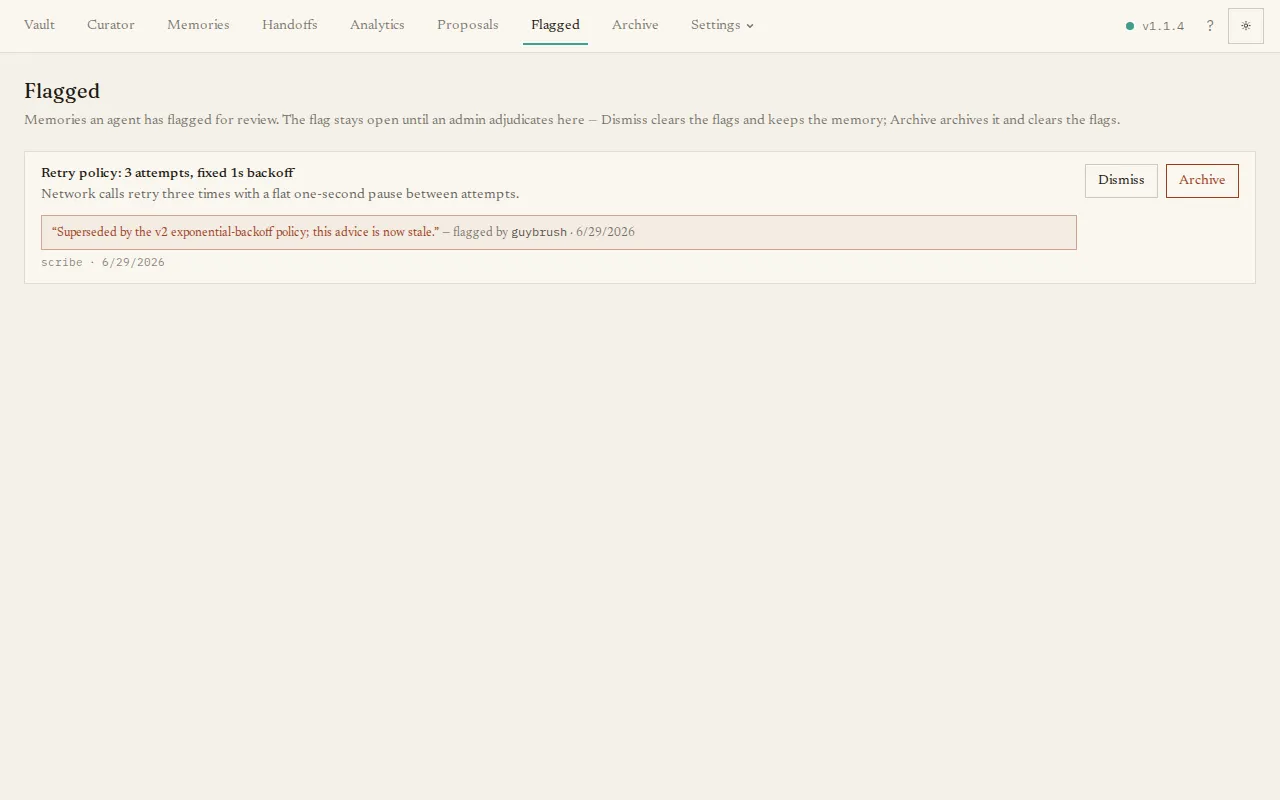
When an agent recalls a memory that looks wrong, it can flag it with a reason rather than changing or archiving it on its own. Flagging moves the memory a few places lower in recall (it still appears when it is a strong match) and asks the curator to look at it again.
How the curator handles a flag
Section titled “How the curator handles a flag”About 10 minutes after the latest flag, the curator runs a small, focused grooming pass. Flags that arrive close together share one pass, and none waits more than 30 minutes. It reads each flagged memory in full, the flag reasons, and the five memories most closely related to it, then does one of these:
- Corrects it. It rewrites or removes the statement the flag reports and keeps the rest of the memory as it was. When its confidence is at or above the auto-apply threshold in Curator settings, the fix applies straight away and the flag closes.
- Proposes a correction. Below the threshold, the fix goes to the Proposals page. Approving it replaces the memory and closes the flag; rejecting it keeps the original and marks the flag declined.
- Archives it. When the whole memory is obsolete, the curator archives it if its confidence clears the threshold. Below the threshold it proposes archiving it instead, and you decide on this page.
- Leaves it. When it cannot tell what is true now, it changes nothing and says why.
When the auto-apply threshold is 0, every correction and archive applies straight away, so the curator sends nothing here for review. The page shows a notice saying so, with a link to the setting. Flags the curator leaves unchanged still appear.
A correction states the current facts; it does not add a “was A; now B” note. The vault’s git history keeps the earlier text. The curator never rewrites a memory it could not read in full (very long memories, or ones with secret-looking text that had to be masked); those are left for you.
Correction uses the Grooming model and runs only while Grooming is turned on. With Grooming off, flags wait here. Before the memory and flag reasons are sent to the model, known secret patterns are redacted. Redaction is best-effort; it cannot guarantee removal of arbitrary sensitive text.
The agent’s flag_memory response reports that the flag was recorded and the
curator will review it; it does not report the outcome. If a persistence error
says the write could not be confirmed, the flag may already be recorded—check this
page before retrying.
What you’ll see
Section titled “What you’ll see”Each flagged memory shows its title, text, and flag details: the reason given, which agent raised it, and when. A line underneath says where it stands:
- Waiting for the curator — it has not reviewed the flag yet.
- The curator proposed a correction — with a link to the proposal.
- The curator made no change — with its reason.
- You rejected the curator’s correction.
- Too long for the curator to rewrite safely.
- The curator proposes archiving this whole memory.
The main task
Section titled “The main task”- Edit — fix the memory yourself. Saving closes the flags.
- Ask the curator again — after it made no change, after you rejected its correction, or after you shortened a long memory. It takes another look about 10 minutes later.
- Dismiss — the flag was unfounded; clear the flags and keep the memory active.
- Archive — explicitly archive the whole memory and clear its flags. The curator never archives a memory on its own.